Planar or Spatial
Exploring Design Aspects and Challenges for Presentations in Virtual Reality with No-coding Interface
Published in ACM ISS (Interactive Surfaces and Spaces) 2024
Introduction
In today’s fast-paced world, the ability to communicate ideas effectively is essential—whether in education, business, or beyond. While traditional 2D presentations have long been the standard, there’s growing interest in exploring the immersive potential of VR as a new medium for engaging and impactful information delivery. As VR devices become more accessible, platforms like Microsoft Mesh are enabling presenters to craft experiences that leverage spatial audio, 3D environments, and interactive elements. Despite this potential, VR presentations remain underutilized by many, especially non-technical users who may lack the tools or guidance needed to create compelling content. Unlike conventional slideshows, VR presentations introduce unique challenges in design, navigation, and user interaction, often requiring specialized authoring tools that are still complex and difficult to use. As we move toward a more immersive future, understanding how to effectively leverage VR in communication will be crucial. This study explores the current state of VR presentations, the opportunities they present, and the key design considerations for making them more accessible and engaging.
Research Questions & Process
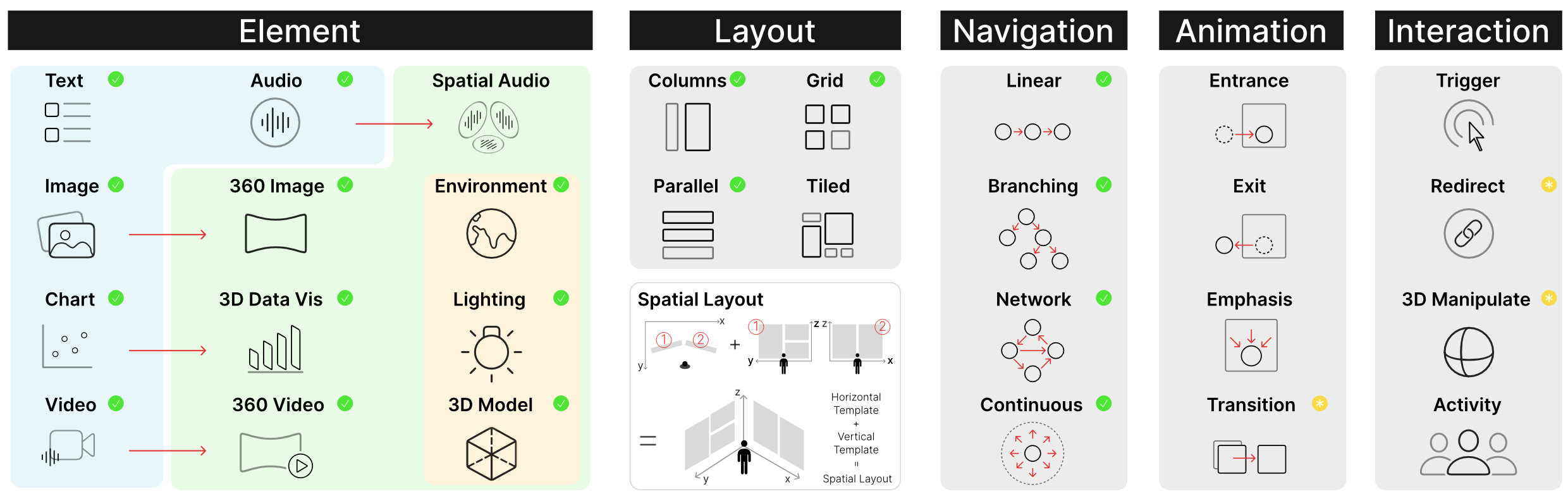
- RQ1 - Design Aspects: What are the common design elements for VR presentations? What are unique to VR and what can be transferred and extended from 2D presentations?
- RQ2 - Challenges: What are the concerns and challenges preventing users from authoring and engaging with VR presentations?
- RQ3 - Opinions: What are users’ perspectives on VR presentations? What strengths and constraints do they perceive about VR presentations?
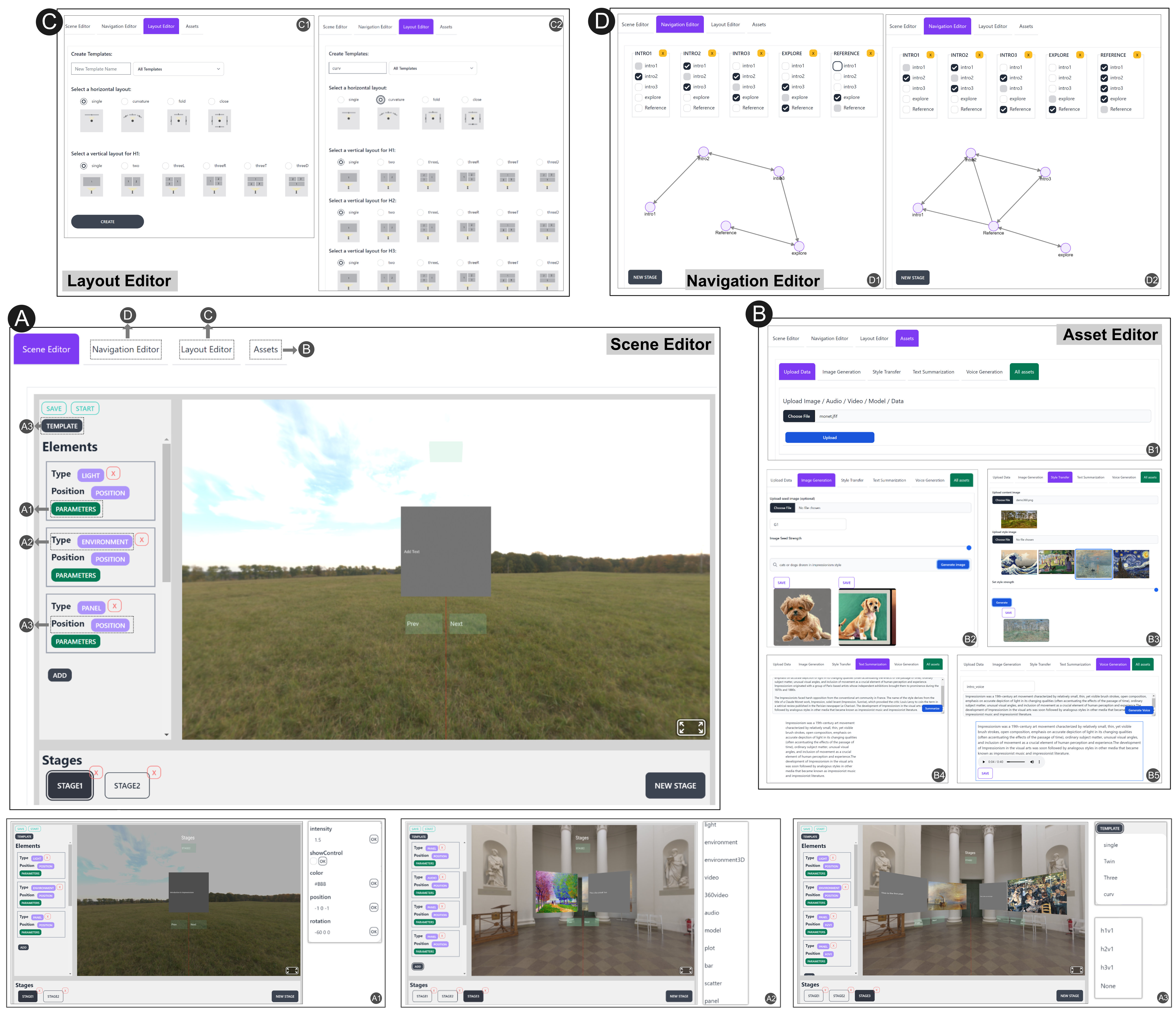
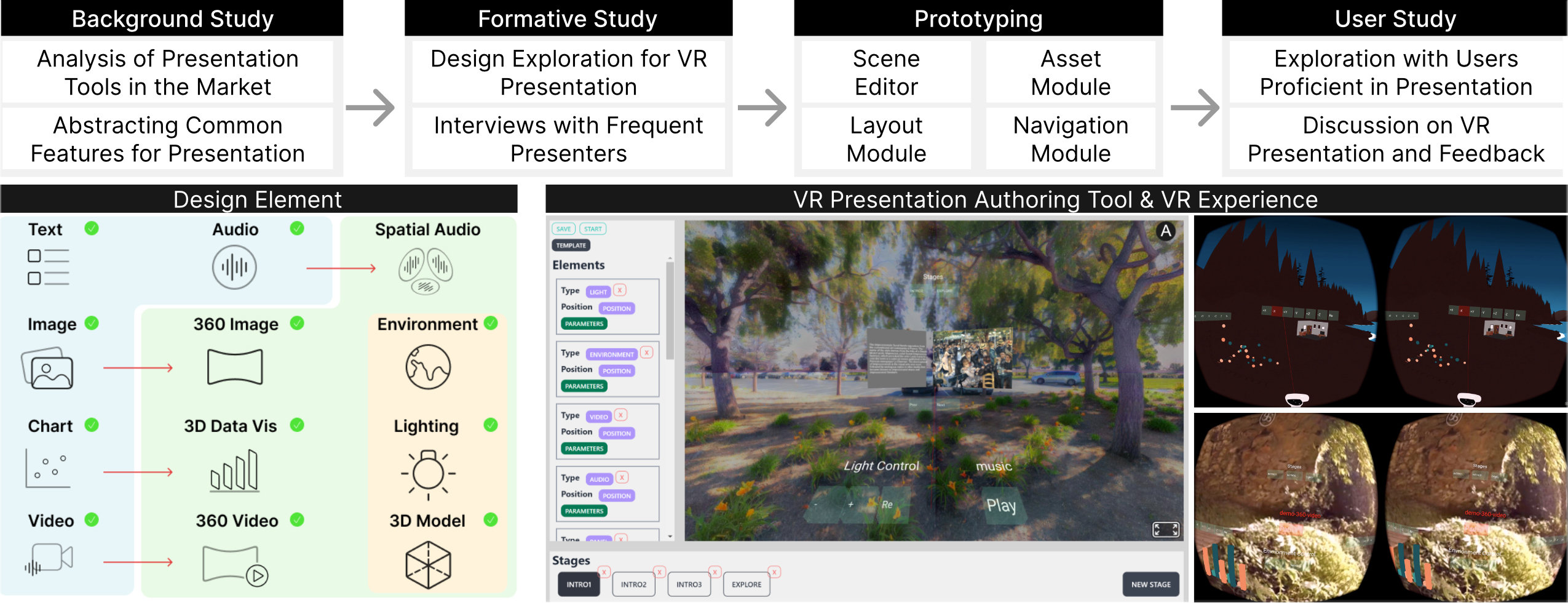
To address these research questions, we conducted a four-stage study. In Stage 1, we analyzed existing presentation tools to identify key design aspects for VR presentations. Stage 2 involved interviews with seven professionals from education, design, and business to uncover challenges and perceptions around VR presentations. Based on this, we developed VRStory, a no-code authoring tool designed to simplify the creation of interactive VR content. In Stage 4, we evaluated VRStory with 12 participants familiar with presentation software, gathering feedback through hands-on use to validate our findings and explore user perspectives.
Research Contribution
- Empirical insights into users’ opinions and preferences on VR presentation and its authoring process;
- A proof-of-concept artifact, VRStory, based on background study on popular presentation tools and interviews with domain experts, leveraging AI features for facilitating VR presentation authoring for non-technical users.